Tuesday, March 26, 2024

CORRADO COROLLA

Corrado Corolla was born in Italy on the 17th of March, 1942 in Canelli, Asti.  In 1959, at age sixteen he arrived in Sydney with this father Eugenio, mother Carolina and brother Angelo on the ship Australia. Corrado`s older brother Sergio was living in Fairfield, NSW and the family stayed with him.   

Sergio had been in Australia since 1954 and also travelled on the ship Australia. He worked for Melosi Small Goods during the day and at night he was a musician, playing the piano accordion.  

Both Corrado and Eugenio got jobs at Melosi and worked along side Sergio. Corrado would later get a second job at Brescia furniture.

Sergio soon married and the family moved, though still in the local Fairfield area. Corrado then got another job for Milano Small Goods, and eventually he would branch out on his own.

Corrado, after watching his brother play the accordion, picked it up and taught himself to play. He then formed his own band and also began to play bass guitar, he was young and into the rock and roll scene. His band also had a lead singer, though Corrado didn’t sing.

In 1963 he was at an Italian picnic that was run by the Friulian Association. It was there that he met Marina Ghidella who was from Wollongong and three years later they married. They had their wedding reception at Luccarda`s reception centre, Tarrawanna.

Corrado moved to Wollongong and set up his own small goods business from his home garage called C & M Corolla, in Gregory Street.  Whilst he was working on his small goods business he still played with his band in Sydney. Corrado would go to Sydney to play the bookings and come home at night.  He continued to do this for a few years.  Traveling to Sydney for the band was too much, so he decided to try and form a new band in Wollongong. It was now 1968.

Over at Warrawong, approx ten minutes south of Wollongong, was a local band called The Latin Beats, who had been playing together for 2 years.  The Latin Beats were a four piece, group of young men, who played at the Warrawong community centre once a month.  It was a gathering where people would come and meet, listen and dance to the music, enjoy the food and the company. Often the dances would be fundraisers for local groups etc. The Latin Beats consisted of a drummer, bass player, guitarist and a button accordion player.

Corrado came to practice with the group, downstairs in the guitarist’s mother`s house. Corrado had experience and could play  a variety of music styles. He replaced the original accordion player and now the Latin Beats were ready for a change.

The Latin Beats no longer played at the community centre and started to play at local hotels and restaurants in and around Wollongong. Two restaurants in particular that they performed at were the Capri at Port Kembla, and the Frascati in Wollongong.  The other thing that had changed was that Corrado began singing with the group.

In 1970 they were given a permanent gig at The Fraternity Club, Fairy Meadow.  They would perform Thursday through to Sunday, with Wednesday being their rehearsal day.

Saturday nights at the Fraternity Club always drew a big crowd.  The Fraternity had a large auditorium for dancing and the Latin Beats were a great dance band covering a range of styles. The Latin Beats also played at other social gatherings outside of the club, particularly cultural events. They often played at the San Giovanni Battista festival in Wollongong. 

In 1972 a new member joined the group, Fred Marsh. Fred was a saxophonist/singer and he had show band experience. It added another dimension to the group. Fred had recently returned from Vietnam where he was entertaining the troops.

The Latin Beats seemed to be going from strength to strength.  They played their usual gigs at the Fraternity Club and often played in other places too. Occasionally you would see them at the Marconi Club in Sydney, or maybe when they played for a wedding at Bruno`s Reception Centre in Tarrawanna.  

In 1975 the band changed their name and were now known as Con and The Latin Beats. It seemed fitting because Con was so well known around the Fraternity Club and the local area as he was still working with his small goods business and he had many customers: suppling restaurants, cafes and other food outlets.

The Fraternity Club held wedding receptions on a Sunday night and the band was usually playing. They were incredibly busy playing music and the work just kept coming. Even Con`s brother Sergio, filled in for him on one occasion.

When Italian singer Nicola Di Bari came to Australia in the early 80`s, Con and The Latin Beats were his backing band. They played at five different venues. from NSW through to Victoria.  Nicola Di Bari was a two time San Remo Festival Winner and an extremely popular singer/entertainer in Italy.

By 1980, Corrado sold his small goods business so he could focus more on his music, as he had opened a music store.  The music store sold instruments such as guitars, drums and accordions as well as sheet music. Corrado and wife Marina went to Ancona, Italy, so they could obtain an import licence to sell accordions back in Australia at their store. Upstairs from his music store was Con`s Music School where he leased out the space to music teachers. By 1985 the music store had closed and Con and Marina rented out the shops that once occupied the store. The music school was still going upstairs.  

They decided to open a delicatessen and once again went back to selling small goods wholesale. The wholesale side of the business picked up quickly and soon they were back supplying food outlets.

In 1993 Con and The Latin Beats became a six member group with the addition of a lead singer whose name was Margot. With a female in the group the dynamics had changed again and it gave the band even more depth.

FRED MARSH

I spoke with Fred Marsh and he spoke with such joy about his time with the band and the impact that they had in the area and for the Fraternity Club.  

Fred spoke about the dance nights on Saturdays at The Fraternity Club.  The auditorium would be packed and they could easily have up to 1000 people. Both men and women were well dressed for dancing and it was always a great night. The band was diverse in its music style, playing everything from Latin to Rock and Roll.  

Nothing was more important than playing at the Fraternity Club.  The band had a huge following and the dance nights became part of the fabric of the Fraternity Club, whether they played upstairs in the main auditorium or downstairs in the lounge.

We also spoke of some of the shows that they did and in particular  when the Fraternity Club ran the Ballroom Dancing Latin Competition over a series of weeks. It was standing room only on Grand Final night.  It was such a popular event that it ran for years and years.

SAM FOLINO 

Another band member I spoke to was Sam Folino. Sam began playing with Con and The Latin Beats around 1984/1985.  He was a bass guitar player.  Sam recalls when he first met Corrado as a young teenager browsing through his music store. Sam was looking at the guitars and picked up one and began playing `tico tico`. Con, who was always so encouraging, got up and accompanied Sam on the keyboard.  That was the start of their friendship. Sam eventually worked at Corrado`s music store alongside Corrado`s wife Marina. When the music store closed down Sam was running the Music School upstairs and was one of the guitar teachers as well. Con`s Music Drama School is still running to this day.

Sam mentioned how at first he used to watch the band playing at the Fraternity Club.  Corrado was generous and often asked him to join in with the group and play. Sam initially played with the group for one year before returning to the group in 1989 until 1997 when the band had finished. For him, Corrado was an entertainer who touched people’s hearts. He also remembers how in the downstairs lounge on a Sunday night there would be hundreds of people dancing the night away, full of joy and having a great time.  Never had he ever seen anything like it when everyone was in sync waltzing around the floor together. It really was special. 

On the 4th of November, I997 at age 55, Corrado Corolla passed away.  It was such a shock to the community. Without Con there was no band and they all stopped playing at The Fraternity Club.  Nothing could fill the void. Con`s funeral was attended to by so many people. His effect on the community was immeasurable. His beloved accordion sounded no more. 

When you think of Con and The Latin Beats, you immediately think of The Fraternity Club. Corrado was larger than life, always generous, jovial and well liked.  The club has never been the same since.

The small goods business still carries on and is run very successfully by his sons, who began working in the business years before. Con is also survived by his wife Marina and their grandchildren.

Even though we have such fond memories of a wonderful time and so many of us remember dancing on more than one occasion to the music from Con and The Latin Beats, when Con passed away it was as if time stood still. The music stopped, the dancing stopped and the joy was no longer there!
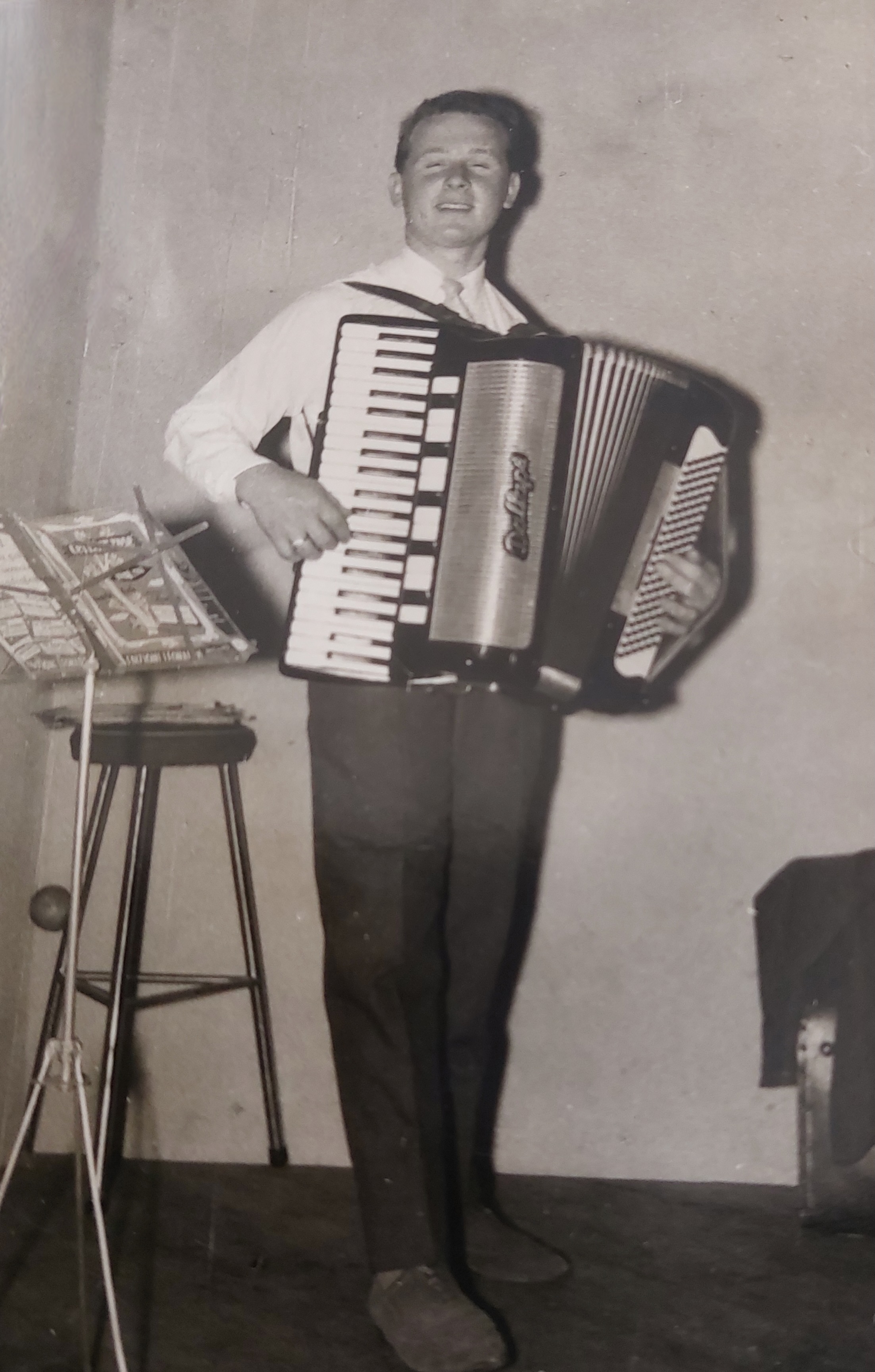


A young Corrado Corolla with his beloved accordion.
(image from the collection belonging to Marina Corolla)


( Images from the collections belonging to:
Marina Corolla, Fred Marsh and Sam Folino)

Wednesday, February 21, 2024

SALVATORE OGGERO - PIZZAIOLO

Arriving by plane when he was just 16 years old, Salvatore Oggero arrived in Australia April 10,1965. He came to Warrawong where he boarded for 3 months before living with his brother Vito, who arrived in Australia August 1st, 1960 travelling on the ship Sydney.  

Salvatore lived with his brother Vito for approximately 1 year before moving to Tarrawanna where he resided at the Luccarda boarding house.  At that time there were approximately 10 -15 boarders and Salvatore kept friendship with some of the boarders, even after he left.  He remembers the good food.

He worked as a concrete labourer for approximately 12 months before commencing another labouring job at BHP (Port Kembla Steel Works). After about six months at the Steel Works he was promoted to Shunter.  He had passed the test having applied for the role and his English was quite good. This was an apprenticeship.  

Around that time the Steel Works employed over 20,000 people and with so many on the job site, accidents happened.  During his time as a Shunter, Salvatore nearly lost his leg. But it was when he lost two work mates within two weeks of each other it made him re-evaluate the situation and he left.  Salvatore was a shunter for two years.

His next job was at Metal Manufacturers (M & M) for another two years before going back to the Steel Works working as a rigger.

Around 1978, having already been married, Salvatore decided to change course and purchase an existing Pizzeria situated in George Street, Warilla.  It was called Pizza Roma and was first opened by Primo Gaggero who was the original owner of Pizza Roma in Wollongong and opened several others in the area.  Salvatore worked with Primo for a short while to see how it operated and became familiar with the running of the pizzeria before taking it over.   

When Salvatore left Italy as a young man he was already doing his apprenticeship as a pastry chef.  So he had experience in the kitchen and with restaurants.  After about 12 months, with renovations finished, Salvatore changed the name of the Pizzeria to Sam’s Pizza. Sam’s Pizza was opened six days per week and operated from 5.30pm - 2.00am.  Monday was his day off.  Not only did he do pizza`s but other trattoria style meals such as Chicken Schnitzel, Pasta and he became famous for his Garlic Bread.  

In a good week he could sell up to 300 pizza`s per day and in a slow week  around 50 pizza`s per day.  He was very busy at Warilla.  There wasn’t anyone else around and not only the locals but many came from out of town because he was open late at night.

In 1983 he sold Sam’s Pizza and went back to his old job Rigging and did this for about 2 years.  In 1985 he opened another eatery at Unanderra. This time he opened it from scratch and it was a Pizza Restaurant.  The Unanderra Pizza Restaurant was more of a family eat in restaurant that also did takeaway.  With seating available for up to thirty people he operated the restaurant six days per week, the same hours as Sam’s Pizza in Warilla, only operating at night.  

The Unanderra Pizza Restaurant was a lot different to Sam’s Pizza. It was quieter and also had a different clientele. Salvatore`s brother in-law was a musician and after short while Salvatore employed his bother in-law and his band members to play music at the restaurant on a Saturdary night. The customers really enjoyed it. The Unanderra Pizza Restaurant was sold in 1992.

Salvatore had a break and in 1993 he began again. This time he went to Cowper Street, Warrawong and opened Romeo’s. It was a new family restaurant and it was bigger than Unanderra.  He also did pizza`s and his kitchen menu offered a wider range of dishes. Salvatore had other Chefs working for him.  There were times when he had to fill in if the chef wasn’t available. Romeo’s restaurant provided music one or two nights per week. After about 36 months he sold Romeo’s.

He went back to rigging for a while contemplating what he was going to do next.  In North Wollongong on Flinders Street, there was a small shopping complex called the Cragmar Shopping Centre. It was very convenient. Having several shops, a small supermarket, chemist, butcher and a real estate upstairs, just to name some of them. Salvatore opened a small Pizzeria. This was an small existing pizzeria shop that faced Flinders Street and it was tiny.   He called it Mystic Pizza.  He did mainly takeaways as well as deliveries.  It was across the road from the North Wollongong Hotel.  The work took its toll and after two years Salvatore closed the shop.  His health wasn’t the best at the time.

After having a break he did some more rigging work before retiring completely in 2010. Salvatore gave us four pizza eateries in the area, cooking great meals for years and years. Here he was another Italian who provided a great service to the community over the course of nearly three decades.  

Salvatore loves playing cards and chess. You can often find him down at Santo`s Deli in Warrawong having a coffee and playing cards with his friends. Once a week he also plays chess in Wollongong.  He learnt to play chess with some of his work colleagues and kept playing for over twenty years.  He plays chess on a Tuesday night socially at the Collegians club. Salvatore is also Nonno to his five grand children. He keeps himself busy!


Salvatore with his young son behind the counter at his Unanderra Pizza Restaurant


All images from the collection belonging to Salvatore Oggero


Tuesday, February 13, 2024

ST. ANDREA- IRPINIA ASSOCIATION

As a young girl growing up in Wollongong I remembered some of the Italian Associations/Organisations that were formed by those in our local community.  The one event that stands out to me the most was the Saint Giovanni Battista festival.  I think the reason that I remember it the most was that on a number of occasions, we as a family went along to celebrate their  annual festival at the then Wollongong Show Ground. There would be entertainment, activities for children and of course, food.

Most associations held events yearly. Occasionally some groups would have picnics, sometimes twice or more in a year.  Over time other groups formed that represented different regions and traditions as well. There were religious celebrations, military corps and choirs groups, all from our beloved Italy. However, as the population aged these groups inevitably got smaller and smaller. Some groups finished all together, others amalgamated and some new ones formed as more of a social get together.  

Most associations were formed as a way of staying connected to each other and celebrating their ethnicity and culture. One such group was the St. Andrea - Irpinia Association. St Andrea di Conza is a small town that is part of the greater region of Irpinia.  It is situated in the province of Avelino in Campania, Italy.

I first became aware of them when I interviewed Vince Cappetta about his family who were the last owners of Bruno`s Reception Centre in Tarrawanna.  Vince began to tell me the story of the St. Andrea - Irpinia Association and I was impressed to say the least.  An organisation that is still going after 40 years!

The Association was formed in 1982 and it became official in 1983. Vince and his wife Maria were an integral part of the Association and they held the first Association Dinner at Bruno`s in Tarrawanna, when the Cappetta family were running it. It just so happened that the Mayor of the town back in Italy was in Australia visiting family.  He also attended the inaugural Association dinner, making it all the more special. The following year they were able to purchase their very own club house: as I said, I was impressed. The group donated money towards their goal and soon they found a perfect place at 180 - 182  Wentworth Street, Port Kembla. The purchase price was $80,000.

It used to be a YMCA in it’s day. It had internal toilets, a large hall and parking. It was perfect. The group, with many members and volunteers worked together and raised the funds to renovate their club house. Internal fixtures were attended to and a kitchen was built once they acquired council permission.  They also in time built an movable wall so they could close off the space if need be, but had the option to open it up for bigger functions.

When they first began the Association, they had picnics and gatherings and many people bought food.  They worked constantly to get to their goal of purchasing their own building and they built up their membership.

St. Andrea - Irpinia Association represents the region and it is well known for their pasta dishes: Cappalletti and Cavatelli. Each year they would celebrate with dinners at their club house and the wonderful women would recreate these beautiful pasta shapes all done by hand.  They would raise money for the club and had the most remarkable dinner at their Wentworth Street, address with up to 120 people attending.  Catered by the group, served by the group and totally enjoyed by all. Everyone helped out and often grandchildren would assist with serving the food and other duties.

Typically they ran two large events per year. The first one was in August were  it coincided with the three day festival of the region in Italy.  They usually cooked Cavatelli. The next event was held in November in honour of  (The Saint) Sant`Andrea, in Italy and at this event they cooked Cappelletti. They were also bottling their own pasta sauce. With Vince Cappetta, there was never any shortage of hospitality experience as well.  With the running of the reception centre at Tarrawanna, he was just as passionate with his involvement with the Association. Saturday nights were reserved for Briscola and Tombola with raffles and prizes given such as pasta, olive oil, passata, wine, beer & chocolates.

When Covid hit, things changed dramatically and when people had to stay home and shelter in place, not much was happening at their club house and they had to find a way to pay the utilities.  Part of the club was divided into office space and leased.  This gave them an income that was used towards land rates, water and electricity.  

Slowly, with time, they went back to operating and running their Saturday night social gathering. Men often play Briscola and the ladies Tombola  with the addition of a pool table and table top soccer for all to enjoy. They are also licensed to sell beer and wine along with light snacks and it is still frequented by the members.  

On the 25th of February 2023 the association celebrated their 40th year anniversary, but without a full sized venue to run their annual dinner, they decided to celebrate their anniversary at the Fraternity Bowling Club, in Fairy Meadow.

Weeks prior to the event the ladies of the Association began preparations for the dinner.  I went along to the club house to see the ladies in action and to speak with them about the work involved.  Let me tell you that the youngest woman in the kitchen was over 50 with others being seventy and eighty  years plus.! It truly was a sight to behold watching them all roll out the Cavatelli . The kilos of flour and the kilos of Cavatelli was just amazing.

I first spoke with Gerardina Scioscia who was overseeing the kitchen.  Gerardina told me that the ratio for each serving was 120 - 125 grams per serve.  It would take 1 x kilo of flour to serve eight people and each kilo of flour needed one egg. The ladies used approximately 55 kilos of flour to make the Cavatelli.  Gerardina was a wiz in the kitchen.  She has been cooking all her life.  As a young 7 year old girl in Italy, twice a week she was making pasta.     

Next I went into the hall where I met Vito Esposito.  Vito was placing all the ready made Cavatelli on the tables to dry out.  There were trays and trays of them.  Once they were ready, into the large freezers they would go.  They had several freezers to fill and the plan was to take the Cavatelli to the Fraternity Club kitchen the day before the dinner. It still was unknown how many people would be attending the dinner at the Fraternity Club. They would end up being surprised at the tickets sales. A total of 320 people attended.  The community were ready to go out and celebrate!

I attended the dinner at the Fraternity Club and it was a great night.  People had so much fun catching up with old friends. The dinner was wonderful with the delicious Cavatelli  There were lucky door prizes, raffles to be won and folks danced the night away,  It truly was wonderful to see such a gathering of the Italian community.  The St. Andrea - Irpinia Association are returning to the Fraternity Club for their annual dinner on Saturday February 24, 2024 with a four course meal.  

With a once membership of almost 240 and the reliance of donations, over the years many foundation members have passed away. The once strong group of 21 women in the kitchen are sadly now just 10 yet they still remain optimistic about the future. The Association is hoping to start doing smaller function/dinners at the their club house. You can often see them raising money at Bunnings with their sausage sizzles on
a Saturday morning.

St. Andrea - Irpinia club house at 180-182 Wentworth Street, Port Kembla 


All images from the collection belonging to the St. Andrea - Irpinia Association.


Wednesday, January 17, 2024

THE MEN FROM SANTO`S DELI

Several years ago a friend of mine told me about an Italian deli in Warrawong. It was situated at the end of a long corridor that started in one street and ended up in a small lane way at the back. I didn’t think that there were any Italian deli’s left in the area. I was pleasantly surprised.

The wonderful thing about this deli is witnessing the `card playing` customers.  Upon my first visit to the deli, the tables and chairs were filled with men playing cards, chatting, with some sipping coffee and others just sitting and watching. It really was fabulous to see. All of these men were retired and most were locals from the area.  

You will find Santo`s Deli Cafe at the end of the corridor underneath the building at 258 Cowper Street, shop number 3.  It is a small shop combined with an eat in cafe.  Santo sells Italian dried goods as well as a selection of cured meats, cheeses and antipasto items.  He also sells coffee, sweet treats and panini.

The deli is run by Santo La Rosa and his wife Judi.  Santo arrived in Australia on the 23rd November, 1968, Sydney, NSW.  He was only 17 years old and stayed with his sister.

His first job was doing formwork and he did this for approximately 7 months.  He then began woking in the building industry and did so for many years.

In 1983 he opened a business at Dee Why, in Sydney.  A cafe style eatery selling Italian panini, gelato & coffee. The cafe also had a pool table and video games.  After four years he sold the business.

Santo then headed to Brookvale and ran the club house for the the local soccer team. There he was serving up Italian style sandwiches, pizza and coffee etc for the local soccer enthusiasts and the Italian community. He worked at the clubhouse for approximately 6 years. He then moved to Henley bowling club.  They had a very small eatery. Santo built it up created a restaurant that also did functions.  In 2003 he finished at the Henley Bowling club.

In 2006 Santo was ready to retire and moved down to Shell Cove on the South Coast of NSW.  He liked the area and it was quieter than the hustle and bustle of Sydney.  Through a broker he saw the deli for sale and looked into it.  Soon he was back in business and serving panini, coffee and selling Italian grocery lines in the small deli business that he and Judi purchased.

The deli had a history in Warrawong.  It was originally built by Rocco Annecchini. The Annecchini brothers were well known in the area for the businesses that they ran. Rocco previously had the Marina coffee lounge in Warrawong and some years later went on to construct the building in Cowper Street where he ran his Cafe/Deli at the back.

When Santo purchased the deli it was being run by Angelo Morello who was the second owner after Rocco. Angelo owned the building as well and sold the deli business to Santo.  Santo added more stock to the deli making it plentiful.   

The deli consists of two small shops.  One side houses the deli and grocery items and the other side is the seating area where you will find customers enjoying their coffee, particularly the gentleman who frequent Santo`s deli daily for cards and companionship.

Over time Santo added a large cheese grater for fresh parmesan and extra shelving for more grocery items.  Many of his customers are Italians and Europeans of course, but he has quite a lot of Australian customers too!  They love his service and products from his fresh cut deli. He always offers his customers a little `taste` of something if they are not sure.  Santo`s Australian customers urged him to stay, as he was thinking of selling at one stage.

The deli is opened seven days per week and Santo starts his day at 7.45am, ready for an 8.00 am opening!  Many come in for coffee and cards and some stay till approx 11 am.  He closes the deli at 5pm.

Covid hit him hard, like it did many, but he managed to push through.  Having no other staff to pay allowed him to trade.  He also has a good landlord. Santo said it was a 50% loss.  People got used to being isolated and many never came back. He is slowly recovering from it.


The Card Players:

Emilio Gigliotti -  came to Australia as a young boy 13 years old.  His father Giuseppe was already in Australia arriving in 1952 aboard the ship Neptunia.  Giuseppe lived at Port Kembla and by the time the family arrived he had purchased a block of land in First Avenue North and built a home for his family. Wife Concetta, daughters Eva Maria, Raffaela, Antonia and young Emilio all arrived on the ship Australia on the 9th of September, 1957.

Emilio began coming to the deli when Rocco Annecchini first had it in the early 1980`s. He knew Rocco very well and growing up in Warrawong he knew many local Italians including those from the surrounding area of Port Kembla.

Emilio made many friends and was also a member of the Port Kembla Soccer Club.  He comes down to the deli nearly everyday for a coffee, chat and to catch up with his friends.

Nicola Reale - came to Australia in 1963 and has been in Warrawong for 60 years. He remembers the early days when Rocco initially had the cafe and it was tiny.  In the beginning it was only a deli on one side where Rocco also served coffee. When the tenants of the shop next door moved out, Rocco then expanded into the second shop and added the eat in cafe to the deli.   Nicola loves to come down the deli, to catch up with friends, read the newspaper and have a coffee, of course!

Angelo Maffullo - came to Australia in 1955 and since retirement comes down to the deli in the mornings for the social get togethers with his friends.  He has been coming down to the deli ever since Santo owned it and some time before that too.

Alfonso Ruotolo - came to Australia in 1970. Another local who worked for 17 years at EPT.  He is a regular at Santos.

Others who have been coming to the deli are Ettore Forlano, Franco Noe`, Giovanni Mastroianni, Allegro Cattunar, Salvatore Oggero and Erminio Carbonara: and these are only some of them.  Most of these men have been regulars at the deli in some way or another since Rocco Annecchini first built the premises. Many of them also remember when Rocco had the Marina Coffee Lounge in the Lakeview Shopping Centre, on King Street. They all commented on how times have changed so much over the years.  Not only have there been many changes, others have passed and friends have been missed.

It was so great to see how they got together on the daily to meet up, play cards, have a chat and sip their coffee. Playing cards also allows their minds to stay sharp and it creates a banter between them that keeps them all a little sparked up as well. Watching them play cards was a reminder to me of my own father who did the same. He would regularly attend the Fraternity Bowling Club at Fairy Meadow on a Saturday.

I remember as a young girl shopping with my mother in Cowper Street, Warrawong and there were at about three delicatessens it that street. There was  also at least one deli in the shopping centre and one on King Street itself.  It certainly is not like that now, with the supermarkets ever expanding their culinary range, they certainly have a stronghold.  Though the memories are still here and staying connected as these gentleman do each and every day is testimony to them.  What a blessing to have spoken with them to capture their contributions to the local Italian Community.


 A young Santo La Rosa, departing for Australia.


All images from the collection belonging to Santo La Rosa


The above video of some of the locals who frequent the cafe/deli 

 all filmed with permission


Tuesday, December 19, 2023

NICOLA COPPOLARO - THE TRAVELLING FRUIT VENDOR

In 1965 Nicola Coppolaro headed to Australia with his family.  Travelling on the Guglielmo Marconi with wife Immacolata and their three sons Pasquale 7, Angelo 5 and 2 year old Mario.  The Coppolaro family arrived in Australia, 20th of May.  

Antonio Cesare, who was a family relative, was living in Lake Heights at 35 Barina Avenue and had arrived in Australia in the 1950`s. After several months of renting a home a few doors down the Coppolaro family moved in with Antonio who had completed renovations on his house with the addition of an apartment for the family to live in.

Nicola Coppolaro soon began working at the Port Kembla Steel Works as a labourer. The boys went to Warrawong Primary School and later Warrawong High. The apartment at Antonio`s house was not very big, but adequate accomodation and the family were in familiar surroundings.

In March 1968 an unfortunate incident took place. Four year old Mario Coppolaro ran out onto the road into an oncoming car and was killed.  Immacolata suffered a terrible shock as she saw her son lying on the road.  It is believed that this may have contributed to her ongoing heart issues.

In 1969, whilst still working at the Steel Works, Nicola started a small enterprise at his house. In the apartment that the family lived in there was a long corridor and Nicola set up some shelves filled with produce and began selling fruit and vegetables from the home at Lake Heights.  The corridor fruit and vegetable store was gaining popularity and he was outgrowing the space. Nicola purchased a truck and began delivering to customers door to door. 1969 also saw the birth of their daughter Elena, who was a dream come true for Immacolata.

Working at the Steel Works, Nicola saved his money and purchased a block of land at 119 Flagstaff Road, Warrawong in 1970. The following year he open his fruit shop that he built on the land.  Approximately six months later he finished building the residence on top for his family to move in.  After living 9 years with Antonio Cesare at 35 Barina Avenue, Lake Heights the Coppolaro family moved into their own home above their Fruit Shop.

At first the shop was just a green grocer selling fruits and vegetables.  Nicola was also doing his travelling fruit run. He would take his truck out several times per week and had a particular run to the Warrawong/Lake Heights/Cringila areas. He not only served the Italian community but many other European communities as well. 

Nicola opened his store seven days per week and would go to Flemington Markets on a Tuesday morning to get all his produce. Nicola ran the shop with wife Immacolata and the children would all help out on weekends and particularly school holidays. They also had one shop assistant. Nicola also bred quails in his back yard and sold their eggs.  

Immacolata found her feet working in the shop and it really was good for her. She spoke little English, but with the day to day running of the shop and dealing with the constant stream of customers it really helped her to pick up the language.

The shop soon expanded its range of goods and began stocking Italian grocery lines and they stocked small goods for the deli section.  It proved to be a good move.  Many a time you would find Immacolata offering a coffee and biscuits with customers or friends just for a chat.  It was like a meeting place. Immacolata was not only hospitable, she became very astute in the business as well. Considering she had little to no education Immacolata would become very wise with numbers and figures even to Nicola`s surprise.  

Nicola began importing glass damigiane (demijohns) and timber wine barrels from Italy and they sold extremely well. So many local Italians and other Europeans made their own wine at home and to be able to have large storage options available locally was a boon for them. In the early 1980`s Nicola`s younger brother Gaetano opened a supermarket at Albion Park.  Nicola supplied Gaetano with fruits and vegetables for his supermarket for approximately  5 - 6 years.

It was around 1986 and the business was doing ok but Immacolata was not in good health as her heart condition worsened. With a young daughter to care for as well, Nicola decided to rent the shop out to so he could care for Immacolata and daughter Elena full time. In 1988 Angelo was married and he and his wife moved to Dapto.

In 1989 Nicola made the decision to sell the premises to the same people who had been renting out the shop. They moved to a newly purchased home in Dapto to be closer to their son Angelo and wife Maureen who was expecting their first grandchild. Nicholas Coppolaro was born and brought much joy to the family. Nicola was enjoying his new home at Dapto, cultivating his garden which produced abundantly. He shared much of his garden bounty with family and friends. After several years Immacolata passed away December 15, 1994 aged 62.

The death of Immacolata had a profound affect on Nicola and the whole family.  This was another loss for them second to death of son and brother Mario at age four. Nicola did struggle for some time, but slowly he found his way back to life. He would go on to marry Concetta Arnone, who was a life long friend. Nicola regained much happiness and once again was back in his garden and his life prospered. More joy came to him when his daughter Elena married her husband Stephen.

Around 2001 son Angelo was diagnosed with Motor Neurone Disease and passed away in 2002.  It was difficult for the family but it was extremely hard for Nicola and he struggled again with the loss. His health began to decline. Nicola Coppolaro passed away December 30, 2007. He was 76 years old.  Both Immacolata and Nicola are survived by their grandson Nicholas. Pasquale has now retired and moved to sunny Queensland and daughter  Elena lives on the South Coast of NSW.

Nicola Coppolaro had his travelling fruit truck for approximately 15 years.  It was a labour of love for him. He purchased a table top truck and designed and welded the frame with different compartments to house all the produce, with a canvas cover made to go over the top. Stopping at certain streets and blowing the horn, his regular customers would be expect him. Nicola`s fruit truck was the original door to door delivery, always with a dedication to service and to his customers.


 Nicola and Immacolata Coppolaro outside their shop in Flagstaff Road.


 Nicola`s travelling Fruit truck.

He designed and welded the internal frame together to display his produce.


All images from the collection belonging to Pasquale Coppolaro


Saturday, November 25, 2023

FRANK CASTELLI - DRUMMER

Travelling on the ship Sydney, Frank Castelli arrived in Australia on the 15th Feb, 1962.  Along with his father Biagio, mother Eugenia and his 13 year old brother Alessandro, the Castelli family headed to Kemblawarra, where they stayed with Biagio`s brother, Angelo. Frank was 10 years old.

Within days of arriving, Biagio began working at the coke ovens at the Port Kembla Steel Works. Alessandro enrolled into Port Kembla High and Frank to Kemblawarra Primary School.  Alessandro took an early interest in music and learnt to play the bass guitar, and later he would to play lead and rhythm. His teacher was Bob Goodger from the Tornadoes.  The Tornadoes were a local rock and roll band originally consisting of four brothers. They were extremely popular and well known playing at many local dances and clubs and would achieve world wide acclaim.  Alessandro Castelli was not the only musician in the family. His Uncle and his Grandfather both played the Piano Accordion and soon brother Frank would become interested in music too!

When Frank was 15, he began guitar lessons but that only lasted a few months.  Frank would watch his brother Alessandro rehearsing with his band at the family home.  Frank was fixated with the drummer and soon he began drum lessons.  Alessandro bought Frank his first set of drums. 

Frank had only been playing for three weeks when he was thrust into a gig, filling in for a musician who couldn’t make it. It was a paid, one off gig in a pub!

Frank kept having lessons and got a position with a band called The Playboys.  The Playboys had gigs here and there and Frank stayed with them for approximately 12 months. In 1967 he then joined his brother Alessandro with his band and became their drummer.  They played a gig at the Capri Restaurant in Port Kembla on a Friday and Saturday night.  The band usually started at 9.30pm and would often finish between 3-4 in the morning, as other venues finished their dances around 12.30pm, many people headed to the Capri to dance the night away. 

The Capri began slowing down and so the band finished up their weekend gigs.  Alessandro, Frank and others formed a band and played for wedding receptions at Bruno`s Tarrawanna. With a variety of lineups with Alessandro`s band over the course of 3 years, Frank left to start his own band.

Frank formed a rock band called Talus Cree. A five piece band that  consisted of two guitar players, one drummer, one keyboard player and a singer.  They soon began to get some work. Around Christmas time in 1973, the band did a whole lot of gigs down the South Coast, from Sussex Inlet to Bega.  Over the coarse of two years, the band played at several different venues.  Soon after that the band broke up. 

Frank went back to playing with his brother in a newly formed band called Orpheus.  They were a four piece band and played at the Wool Shed at Piccadilly, that was situated above the Motel in Crown Street, Wollongong.  They were quite successful and got a lot of work. They even cut a record!  They worked at the Wool Shed during the evening, from Wed - Sat. Orpheus played from 1974 - 1975.

Orpheus had band uniforms, but they felt they needed a more professional look.  Frank was good friends with Vittorio Guida. Vittorio Guida was featured in part three of our Tailors of Wollongong story. Frank asked Vittorio to make them some new band attire and Vittorio fitted them out with some really funky and cool, well made clothes.  

The band soon began working at Berkeley Sports and Social club every Friday night and at Nowra Ex-Servicemans Club every Saturday night.  They did this for 2 1/2 years. They then expanded the band from a four piece to a six piece. With a lead singer and a saxophone player, it took the band to the next level.  They played many gigs at both the Windang and Warilla Bowling Clubs. In 1979, Frank went overseas for five years on a working holiday.

In 1984, Frank returned from Italy. About 5 years later an opportunity came up to join Alessandro’s band who were already playing at the Portofino Lounge. After being away from bands for a total of 10 years, Frank joined his brother once again to play the drums.  It was another four piece band with an accordion player, drummer, bass and lead guitar. They would play occasional gigs for weddings at The Portofino Lounge and Centro wedding reception centres in Wollongong.  

Work began to slow up, meanwhile the band`s bass player was doing gigs with another accordion player and had asked Frank to play drums for them. Sometimes they played casual gigs at the Polish Club that was also in Wollongong and The German Club, situated at Berkeley.

Frank was working full time in Sydney and had to juggle working life with the band. The band was bringing in extra money, but it was still hard to balance the two.  Frank played his last gig just before 2000 at The German club.  Frank’s brother Alessandro still plays occasionally, everything from latin, current pop and covers. Frank Castelli played for 25 years over a 33 year period from 1966- 1999.

Biagio Castelli passed away June 25, 2007.  He was 84 years old.  Eugenia Castelli passed away August 2, 2019.  Eugenia was 93 years.  They are both survived by their 7 grandchildren and 11 great grandchildren.  Alessandro`s two sons played guitar in bands and two of Frank’s grandchildren learnt drums for a short while.  Musicians over three generations.


The house where Frank grew up in Italy.  The family lived in an upstairs apartment.  His Uncles lived with their families in other apartments upstairs.  Down stairs there was a stable for the dairy cows, a store room and two school rooms where Frank began his primary school education.


The Castelli family soon after arriving in Australia at Kemblawarra in front of Angelo Castelli`s house.   


Frank at 16.  Practicing his drums underneath the family home.


All images from the collection belonging to Frank Castelli


Thursday, October 5, 2023

THE DE PERON FAMILY

 In 1961 the De Peron Family arrived in Australia aboard the ship Aurelia.  Giuseppe with wife Vittorina and their 8 year old daughter Anna, arrived in Melbourne, Victoria.  The De Peron family paid their own way to come to Australia bringing their worldly possessions with them in five large trunks.  They also were fortunate to have had a good amount of money which helped immensely!

Initially, Vittorina (whom everyone knew as Vittoria) didn’t want to come to Australia with Giuseppe. She wanted him to come first, find a place and a job then send for his family.  Vittoria`s mother was not so sympathetic to her hopes and told her that as a wife, she must follow her husband.

Traveling on a cattle train the family were taken to Bonegilla Migrant Camp, near Wodonga.  Back in Italy, Giuseppe had worked in a factory that made ladies stockings so he thought that Melbourne would have more opportunity.  Sadly, this was not the case, as in 1961 there was high unemployment.  There were even riots within the camp from frustrated migrants who were desperate to find work even though part of their travel agreement was the promise that employment would be allocated.

Relatives in Italy had contacted their cousin Domenico informing him that the family were in Victoria. Domenico had arranged accommodation within the house he was dwelling and made provisions for Giuseppe, Vittoria and Anna to come and stay with him.  He traveled to Bonegilla by train to bring the family to NSW.  Domenico filled out all the necessary paper work at the Migrant Camp and was now responsible for them.  The family only stayed at Bonegilla for three days.  Together they caught the train back and settled in the boarding house at Illawarra Road, Port Kembla.

Within two months Giuseppe acquired a job at the Steel Works thanks to Domenico who helped him find employment.   Giuseppe began working as a labourer and within a short while the family moved into a small two room apartment.  The apartment had a kitchenette along with a shared bathroom.

Five months later, in November 1961, Giuseppe and Vittoria purchased their first home in Warrawong.  It was a two bedroom fibro house on a quarter acre block.  Giuseppe didn’t drive so the location was good as it was close to the Steel Works and sometimes Giuseppe would ride his pushbike to work.

Around 1962, Vittoria got a job at the Capri Restaurant in Port Kembla. Working from 4pm - 10pm her job involved waitressing and working in the kitchen.  The Comelli Family owned the Capri Restaurant at the time.  Vittoria was a bit shy, but was happy to have a job.  She was glad she was contributing to the family.  Anna would often walk past the restaurant on the way home from school at St Patrick`s, in Port Kembla.  Her mother would give her a drink or something to eat.  Vittoria worked for approximately 18 months at the Capri.

Whilst Vittoria was working at the Capri, Giuseppe was actively involved with local soccer.  You would often find him down at the oval training and playing soccer with the many young, enthusiastic Italian soccer players.  He carried on doing this for many years and would become one of the first club president for Port Kembla FC in 1966.  

In 1964 Giuseppe and Vittoria took out a large loan for 10,000 pounds, which was a lot of money at the time.  They purchased an existing delicatessen in King Street, Warrawong.  They were able to rent out their home as the delicatessen had a flat upstairs and so the family lived above.   Anna recalls how as a young 11 year old she was translating at the Solicitors office for all the legal papers for her parents to sign.

Having the shop changed Vittoria and she really came into her own.  She loved being her own boss, running the shop her way.  She was a natural born business woman.  Giuseppe and Vittoria purchased the deli from Giorgio Contarin.  Giorgio`s brother Luigi was running his own deli with his wife Irma, in Wentworth Street, Port Kembla.  

They renamed the deli G & V De Peron Delicatessen. Giorgio worked with the De Peron`s for one month to help them learn about the business and how it functioned etc.  They kept the same staff and the same suppliers.  They sold lots of Italian grocery lines and general groceries as Giorgio did, that also included small goods.  They even sold wine, beer and spirits, silently of course.

When Giorgio was running the deli, he did quite a lot of home deliveries.  This was a huge part of the business.  Giuseppe continued on with the home deliveries when he purchased the deli, as the delivery van was included. He would even do runs up into the southern highlands.  They had customers from as far as Robertson and Bowral.

As the business began to grow they upgraded their slicers, they purchased a coffee grinder and a parmesan grinder too.  They were also selling kitchen ware.  G & V deli even sold bomboniere.   Anna often helped out in the shop, as she did from the get go and they built up quite a loyal following.

Prior to the deli, Vittoria was attending free English language classes and Anna would help her practice her homework.  But with the deli Vittoria almost stopped using English as most of her customers were Italian as were most of the sales reps.   On the occasion when they had an Australian sales rep she would do a basic order in English.  Giuseppe’s English was much better as he was working with other Australians when he was at the Steel Works.

The deli was just the thing that Vittoria was waiting for and she ran the deli like she had been doing it forever.   She knew how to treat the customers, she knew when all the different Italian groups would come in and accommodated to them accordingly.  Often, when it was quiet, she would let the other staff run the shop whilst she would take a customer upstairs and share a coffee and a much needed conversation for some of the women who were struggling and often lent them money if they needed it.  Vittoria became their confidant.

Vittoria and Giuseppe both ran the shop with Giuseppe being more behind the scenes.   Vittoria was more than capable of running the deli on her own and she did it wonderfully. Vittoria was front of house and blossomed in the role.

In 1968, Giuseppe got a job in the mines.  He was very fortunate that he worked swing shifts and was able to accommodate all the home deliveries for the deli.  They continued with their home deliveries right up until they sold the deli and all home deliveries were free of charge.

Around 1976/77 there were shifts in the retail industry.  More supermarkets were opening, offering continental grocery lines as well as other delicatessens opening nearby.  It was for this reason that they scaled down the deli and just focused on the small goods and Italian pantry staples.  The  Italian kitchenware items were still a major selling point.  Items such as pasta machines, coffee percolators, coffee grinders, colanders and crockery.

Finally, in 1980 they sold the deli.  During the last few years at the deli Vittoria had some health issues and required major surgery.  The deli sale was needed for her to recover as she was out of action for three months. Anna was now 27 years old.


Anna De Peron

When Anna arrived in Australia she spoke no English and when she went to school in Port Kembla the Italian children who were there only spoke Italian dialect, not proper Italian as she did.  At first Anna struggled to understand them but quickly adapted.  She picked up her English relatively quickly too, in about 3 months.  Anna was also quite smart and did well at school.

Anna went to St Patrick`s Catholic School at Port Kembla and then went to St Anne’s High School at Dapto.  St Anne’s High School finished at Year 10, so Anna finished of her high school years at St Mary`s College in Wollongong.

Anna’s father Giuseppe was quite forward thinking and encouraged Anna to do whatever she liked.  He would encourage her to go for her dreams, or even to travel to Italy.

As she began studying Year 11 at St Mary`s, Anna and some of her friends enrolled in language studies that was part of the school curriculum but not offered at the high school.  So, on a Saturday morning Anna and her friends would take the train to Sydney University for a 3 hour lesson of Italian, from 9 am - 12pm.  Anna had such a great time.  Many times they would venture off into the city, shop around, have lunch and explore the vastness that was in front of them.  They all looked forward to their Saturday adventure.

In 1971 Anna finished her high school education.  She then enrolled at the University of NSW to study Spanish and French as well as History.  It was a three year full time course that through her parents support, she was able to live on campus.  Anna was still helping out at the deli when she could.  While studying at University Anna met her future husband, a young man from Port Kembla.

In 1976 she got a job at St Mary`s College in Wollongong teaching English and History. Through working at St Mary`s she would often get asked to help out with languages.  Gradually she was getting more work with languages so she enrolled at Wollongong University and continued to further her studies of Italian.

In 1980 she was teaching senior Italian classes at St Mary`s. Unfortunately, Anna`s marriage broke up in 1984 and she decided to re-invent her life.  In 1986 Anna took her long service leave and went for a well earned trip to Europe for 3 months. When she came back she worked for another two years before finishing her teaching at St Mary`s College.  Anna taught at St Mary`s for a total of 12 years before resigning.  Anna was keen to go to Italy and stay for a while.

She got a job with ` DE AGOSTINI SOCIETA` GEOGRAFICA ITALIANA`  working as a translator and teaching English to adults, privately.  Anna loved Italy and the freedom it gave her as well. After 3 years she came back to Wollongong because she missed Australia and her parents.

Coming back to Wollongong Anna struggled to settle down.  Anna’s friends suggested to come and stay with them in Innisfail, which is a regional town over an hour away from Cairns.  Anna headed off enthusiastically on this new adventure, but found it to be quite isolating at first.  She was fortunate though because a new TAFE was opening and Anna soon landed herself a job teaching English to `Hmong` refugees.  Anna enjoyed the job as she was able to run the classes her own way that lead to her running her own department.

Living in Innisfail gave her the opportunity to explore far North Queensland.  She also became aware of the large Italian presence there and took an interest in the stories people told her of the early days of cane cutting.

After nine years the TAFE closed down.  Anna was out of a job, but not for long.  She was offered work teaching Italian at a Primary School and a Grammar School on the Sunshine Coast.  These jobs only lasted a short while.  Anna realised that there was a demand for adult language learning as many residents on the Sunshine Coast were retirees who loved to travel to Europe and South America. Anna took a gamble and decided to open her own language school.

She placed an add in the local papers and rented out rooms at the Wallace Centre, Noosa and the community centre at Coolum.  She quickly built up her students to about 50 per week.  At this stage she was teaching French, Italian and Spanish and had to hire more teachers to help with the demand.  It was a very high energy job. The school was doing very well.  She soon let the French go and just focused on Spanish and Italian, from beginner to advanced.
 
In 2017 everything changed as Giuseppe started to become unwell and it was difficult for Vittoria to cope.  They were both elderly and on their own with no help.  Anna closed down the school and headed back to Wollongong.

Anna stayed in Wollongong for about two years and was happy to care for her parents, but she wanted to head back to Queensland.  So, Anna Giuseppe and Vittoria headed back and once again were living as a family.  Due to her many students, Anna managed to start up some classes and was working 2 - 3 nights per week.

Covid came along and Anna couldn’t do much. She just kept one class but eventually she just stopped all together.  On the 15th of April 2020, Giuseppe passed away.  He was 97.  The following year in 2021 Vittoria passed away on her birthday, the 29th of December.  She was 93 years old.

It was a lot for Anna to deal with and she is now just getting through it all.  Anna found a love for painting and her walls are now adorned with her many creations.  She also loves to travel and is keen to venture out again.  One thing that is close to her heart is keeping her family’s story alive.  Anna has begun writing her family history. Like me, she understands the importance of documenting her parents life and the contributions that they made to the vast Italian community.  Giuseppe and Vittoria are but one of the many couples who served us with love and kindness and created many memories and unforgettable moments!
  
 
1961 aboard the ship Aurelia, in Malta and bound for Australia.
 
Anna, (with the blue shirt) teaching a class at her language school    


All images from the collection belonging to Anna De Peron

SONIA RUBBO

Antonietta Galella arrived in Australia December 14,1958 aboard the ship Roma along with her mother Maria and her sister Vicenza.  Antonie...